Continuous Integration and Continuous Delivery/Deployment
Contemporary software users look forward to quick updates, impeccable performance, and continual innovation. The development teams require a process that facilitates a continuous flow of code between idea and production in order to satisfy those expectations. That is where Continuous Integration and Continuous Delivery/Deployment (CI/CD) comes into the picture. CI/CD will enable organizations to produce high-quality software in a short amount of time and in a consistent manner without compromising on its reliability by automating the process of code building, testing, and release.
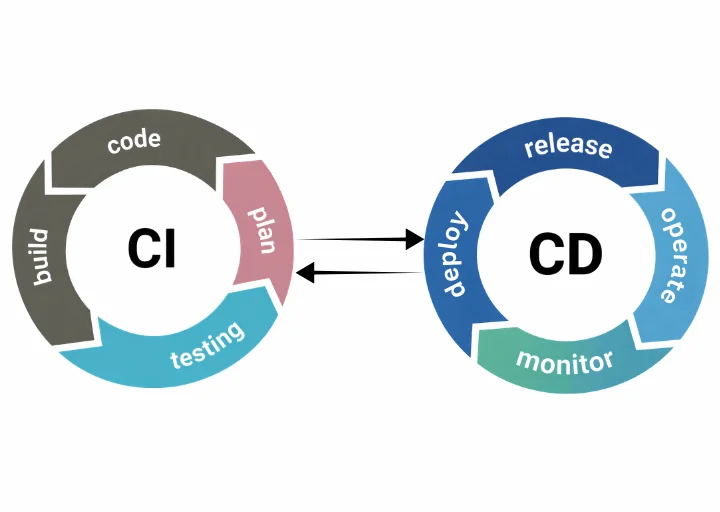
Definition
Continuous integration (CI) is a recent software development practice where small and frequent code changes are made by the developers. The changes will cause auto-building and auto-testing processes, which will make sure that the new code will be reliable when it is integrated into the shared repository. This will minimize the integration problems and enhance the overall code quality.
Passing code CI checks changes to the continuous delivery or continuous deployment (CD) phase. This phase involves the development of validated code ready to release in a fast and efficient manner. The CI/CD pipeline in the software development lifecycle is the automation of the process that moves code changes, usually in an incremental way, from the desktop of a developer to production in a reliable and streamlined process.
Why is CI/CD important?
CI/CD allows companies to deploy software in a more efficient way. Teams can deliver products to the market at a faster rate by automating integration, testing, and delivery processes. Continuous delivery and continuous deployment keep code in a deployable condition and deploy it to production, respectively.
This continuous stream of improvements and bug fixes enhances the product’s stability and satisfaction for the customers. Rather than a massive release of changes every now and then, the smaller updates delivered by the teams more often will result in reduced downtime and enhanced responsiveness to market changes.
What is the difference between CI and CD?
Continuous integration (CI) lays emphasis on the development stage. Small code modifications are often committed by developers, and they are built and tested automatically. Due to the size and complexity of applications in the modern world, automation is needed to make applications developed in a reliable and repeatable manner. CI also makes code integration a little easier and provides developers with more time to be creative and develop features.
Continuous Delivery (CD) is a process initiated when codes have passed integration tests successfully. It also automates the code transfers between the compiled code and staging, testing, or development environments. This will ensure that there are always applications in release-ready states.
Continuous deployment does even better. All the changes that are automatically tested are made directly into production. This is capable of making several deployments in a day. After regulatory or compliance-driven organizations are not limited by these requirements, continuous deployment is the utmost in agility and automation level.
Simply put, CI controls activities in the active development, whereas CD controls activities in the developmental process after the development has taken place.
How does CI/CD relate to DevOps?
DevOps is an integration of cultural values, culture, and software, thus created to enhance the capacity of an organization to offer applications and services more quickly than the conventional development paradigms. DevOps would assist companies to serve their customers and stay ahead of the competition, as it is faster and more collaborative.
In DevOps setups, most organizations have adopted security at all stages of the development lifecycle-a phenomenon called DevSecOps. This does not see security as a last gate in the software development life cycle (SDLC) but rather as a form of security testing and validation implemented throughout the software development life cycle (SDLC.
Incorporating security early and regularly enables the teams to detect vulnerabilities earlier and make sound risk decisions. Conventional methods of security that put testing at the end of production are unable to match the pace of agile DevOps. The current security tools should be integrated naturally into the professional development experience and the CI/CD pipeline without demoralizing the delivery pace.
CI/CD pipeline is the key aspect of the broader DevOps and DevSecOps. The tools used to implement and maintain a CI/CD pipeline should be able to identify bottlenecks and minimize friction to ensure successful implementation and maintenance in an organization. An integrated toolchain also embraces teamwork and facilitates continuity in development and deployments.
What AppSec tools are required for CI/CD pipelines?
The biggest problem with teams that have a CI/CD pipeline is ensuring that there is a high level of application security without slowing down the pace of development. The pipeline should not be secured afterwards.
It is important to conduct security testing at an earlier stage in the development life cycle. This is particularly relevant to DevSecOps teams, which rely on automated testing of security as a way of keeping up with a fast release cycle. The choice and execution of the correct tools in the corresponding stages will minimize the friction, accelerate the release speed, and improve the general quality of the products and efficiency of the working process.
How can CI/CD help with your DevSecOps effort?
Continuous Integration and Continuous Deployment (CI/CD) is a reinforcement of DevSecOps since it entails integrating security checks within the development pipeline. Early and automatic testing tools scan the code in search of vulnerabilities, misconfigurations, and compliance problems. This type of detection in the early phase enables teams to resolve issues within a short period, decrease the level of risk, and provide secure code prior to the deployment.
CI/CD also enhances consistency and minimizes human error through the process of automation in building, testing, and deployments with in-built security measures. Every change is automatically provided with security policies, code analysis, and compliance checks. This will provide unceasing follow-up, quicker remediation, and enhance cooperation between development, security, and operations groups across the software delivery life cycle.
What are the benefits of CI/CD?
- Automated testing facilitates ongoing delivery, enhancing the quality and security of software and adding overall value to the code.
- CI/CD pipelines help save time in the time to market of new features, and customers have better satisfaction, as well as the development teams being less pressured.
- More rapidity and regularity ensure improved competitiveness in an organization.
- Automation will enable the team members to work on high-value work and strategic uncertainty instead of conducting manual labour.
- Companies that have mature CI/CD engineering are better positioned to stand out as the cream of the engineering crop, as teams no longer rely on the traditional waterfall models and also do not have dependency-laden, highly repetitive processes.

Principal Consultant